

Auction Sheets Explained
Every car sold at a Japanese auction is inspected before it goes under the hammer, and the inspector writes what they find on an auction sheet. It grades the car, records the verified mileage, and maps every mark on a diagram of the bodywork. It is the most honest document that exists about an imported car, because it was written before anyone was trying to sell it to you.
Burraq Motors will give you the sheet for any car here, and you are welcome to have it checked by anyone you like. This page explains how to read one.
What one looks like
The layout is fixed, so once you have read one you can read them all. The top band carries the car and its grade, the right-hand column lists equipment, and the diagram at the bottom is where the inspector marks what they found.
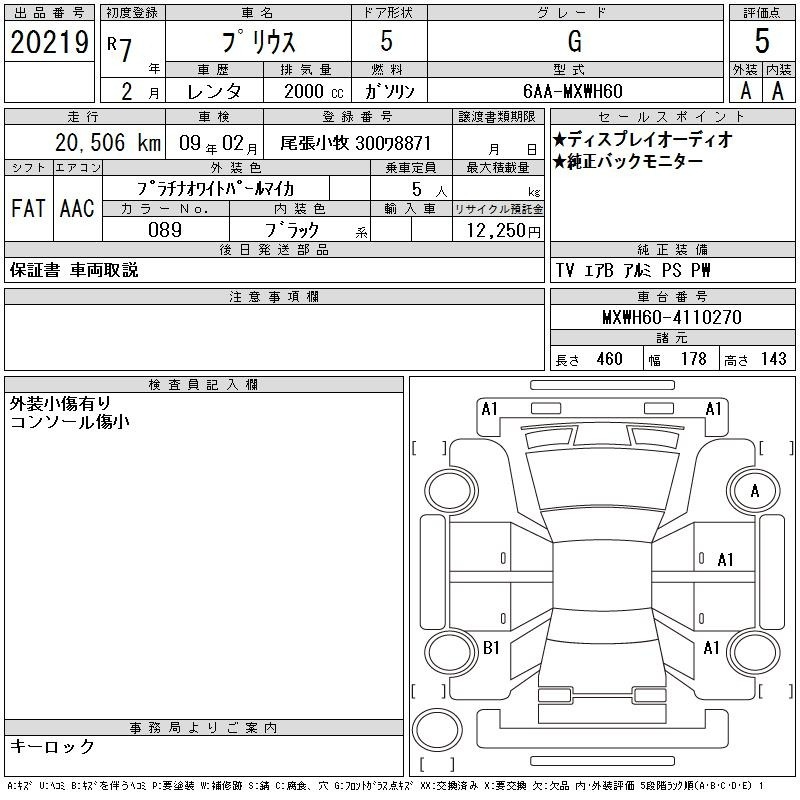
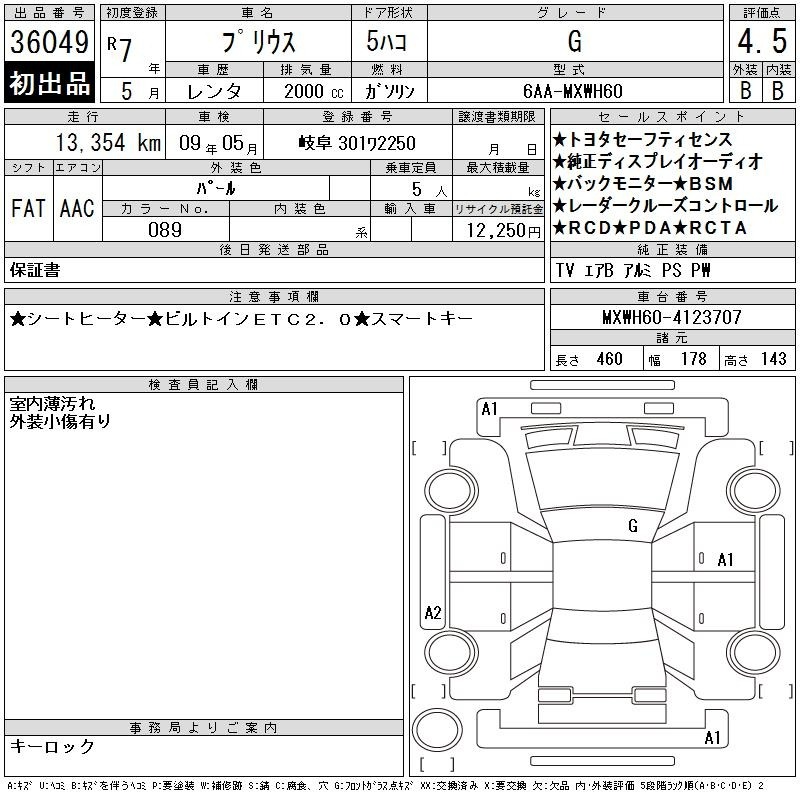
Example sheets, shown so you know what to expect. The sheet for a car you are looking at will be that car’s own.
The overall grade
The single number in the top-right corner. Pick one below to see what it means for condition and for buying risk.
Good used — minor flaws
Where most sound imports sit, and the sensible default to search on. Solid car, minor cosmetic issues, nothing structural. Read the letters too — a 4 can still have a tired interior.
- Buyer take
- Safe baseline for most imports
- Risk band
- low
The grade is a summary. Always read it with the damage diagram below — two grade 4 cars can differ by a scuffed bumper or a repaired wing.
Interior and exterior grades
Two letters, separate from the headline number, in the top-right of the sheet. They are worth as much attention as the grade — a car can score 4 overall and still have an interior graded C.
| Letter | Exterior | Interior |
|---|---|---|
| A | Pristine | Like new |
| B | Small marks | Light wear |
| C | Visible scratches or dents | Stains, needs cleaning |
| D | Needs bodywork | Tears or heavy wear |
| E | Very poor | Needs restoration |
The damage diagram
The car drawn from above, with a code written wherever the inspector found something. A letter says what it is, and where a number follows, it says how bad — 1 is slight, 4 is severe. This is the part worth reading properly.
- A1 – A4
- Scratch. The number is severity — A1 is a fingernail mark, A4 is deep and long.
- U1 – U4
- Dent with the paint intact. Again 1 to 4 by size.
- B
- A dent with a scratch in it, usually from a knock.
- E1 – E4
- Dimples or hail damage — many small dents across a panel.
- W1 – W4
- Wave, meaning previous bodywork. W1 is barely detectable, W3 is obvious.
- S1 – S4
- Surface rust.
- C1 – C4
- Corrosion. More serious than surface rust — it has started eating the metal.
- P
- Paint mark or touch-up.
- X
- Panel needs replacing, and had not been replaced when inspected.
- XX
- Panel already replaced. Routine on bolt-on parts like a wing or bumper.
- G
- Glass chip or crack — windscreen or a light unit.
- Y
- Crack, usually in plastic such as a bumper.
One last thing worth knowing: XX simply means a panel has already been replaced, which is routine on a bolt-on part like a wing or a bumper and is not the same as accident history. R or RA on the grade is the one that means structural repair.
Common questions
The three things people ask us most once they have seen a sheet.
- Is grade 4 good enough?
- For most buyers, yes — it is the market's sensible default. A 4 means a solid car with minor cosmetic flaws, which is what an honest ten-year-old vehicle looks like. The grade on its own is not the whole answer though: read it with the damage map, because two grade 4 cars can differ by a scuffed bumper versus a repaired wing.
- What do R and RA actually mean?
- Both mean the car has accident or structural repair history. RA is generally the lighter of the two, but neither is a number on the same scale as 4 or 5 — they are a flag. Treat any R or RA car as one you do not buy until somebody has read the full sheet and told you exactly what was repaired and how well.
- Why are there letters as well as a number?
- They measure different things. The number is the inspector's overall verdict on the car. The letters are two separate marks — one for the exterior, one for the interior — so a car can be a 4 overall with a B exterior and a C interior, which tells you the bodywork is tidy and the cabin needs a clean.
Ask us for a sheet
Tell us which car you are looking at and we will send you its auction sheet. If anything on it needs explaining, ask — we would rather you bought with the evidence in front of you.
Or call 07462 187617.